Working groups
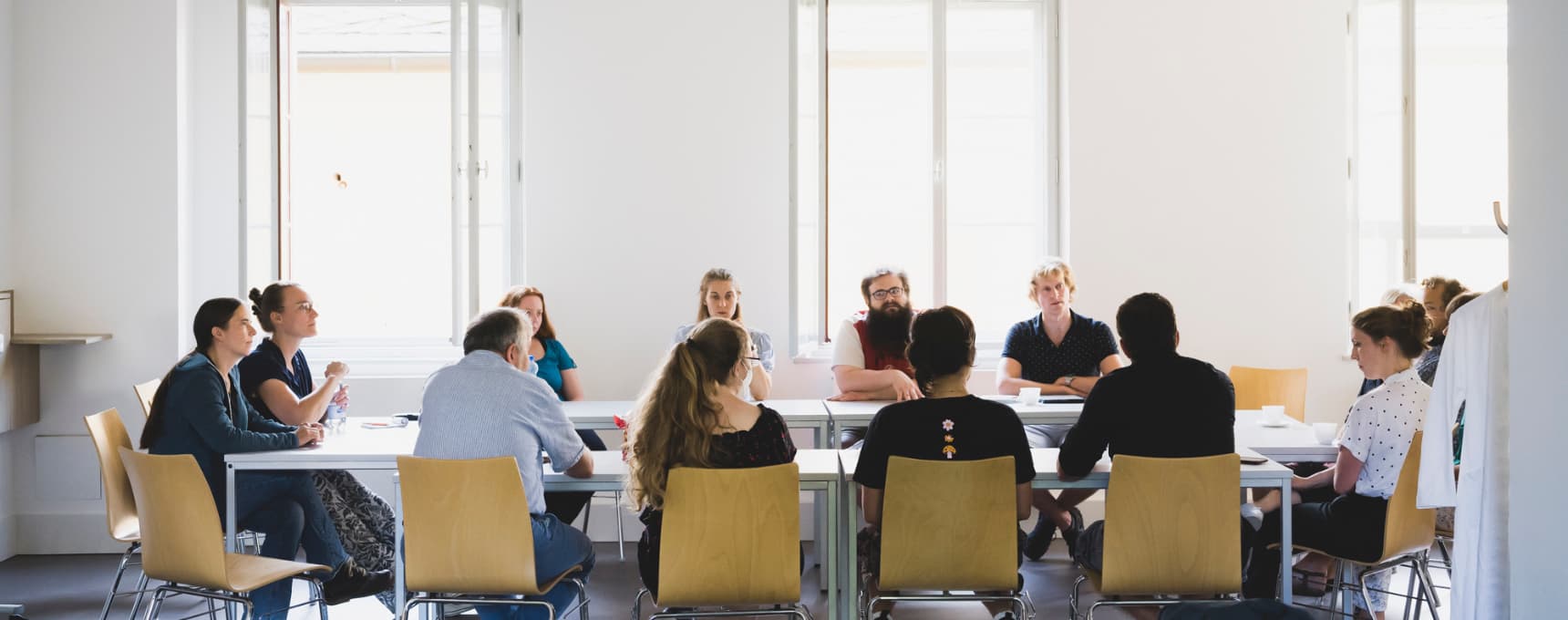
The members of the Young Academy work together in interdisciplinary working groups on diverse research topics. They regularly organise workshops for the scientific community as well as public events with subject experts. The members also communicate their research findings to the general public in podcasts, interviews and other science communication formats.
Artificial Intelligence
Members: Clara Wenz, Fabian Hutmacher, Matthias Stadler, Tobias Lutzi, Golo Storch, Johanna Eichhorn, Kilian Schober, Klaus Wagenbauer, Christoph Heilig, Robert Mayer
The Artificial Intelligence working group is investigating how artificial intelligence is transforming science and research. This rapidly rising technology has the potential to revolutionise traditional approaches to science. The working group focuses on the latest advances in the technology and the many possible applications. In medicine, for example, AI enables more accurate diagnosis and individualised courses of treatment. In the field of astronomy, it speeds up the discovery and classification of celestial bodies and thus deepens our understanding of the universe.
At the same time, however, the working group shines a light on the challenges posed by AI. Data protection, ethics and the potential for distortion (bias) are key concerns, as is the possible impact on society of automation and AI systems in decision-making. The working group covers all aspects of AI – from interesting opportunities to potential risks. Its objective is to develop a wider understanding of AI’s impact on science and find ways to harness this technology in a responsible and forward-looking manner.
Science Communication
Members: Svetlana Efimova, Alexander Rudolph, Maik Luu, Carolin Müller, Charlotte Wendland, Jérôme Schäfer, Christiane von Bary, Verena Streibel, Christoph Wiesinger, Nathalie Lackus, Anna Stöckl
Researchers nowadays are expected to communicate their research in a way that is comprehensible to the layperson and to examine its societal relevance and applicability. The COVID-19 pandemic opened people’s eyes like never before to the need for clear communication of science issues and scientists’ ability to solve problems. Scientists provide factual guidance for political decision-making and the associated public debate. But there are also people who question the authority of experts, and who regard scientific findings as “opinions”. The pandemic also showed that expertise is often challenged by counter-expertise. The arenas and channels that are now used for public debate and announcements have become more diverse – which means that science communication is also more varied and topical than ever.
The working group wants to discover the challenges and opportunities this development will bring for researchers: How important is dialogue between the scientific community and the general public, and how should researchers approach this? What are the potential traps to avoid in science communication and which qualifications are required? And what are the conditions that apply to young scientists? When does a visible media profile become a disadvantage?
Closed working groups:
Open Access as a New Scientific Publication Medium
Members: Barbara Lechner, Franz Schilling, Peter Schwardmann, Klaus Wagenbauer (Sprecher), Johanna Eichhorn (Sprecherin), Matthias Stadler, Kilian Schober
Digitalisation provides new options for communicating scientific data and information. Open access is a hot topic in this connection. The working group investigated the role this model is likely to play in the future as an alternative to traditional means of publication, which are often not free of charge.
In general terms, open access is the strategy of making scientific publications and data freely available to everyone. This provides an alternative to the traditional forms of publication, such as journals or books. At the same time, procedures are being developed to make the reviewing of scientific publications more transparent. In an open peer review, the evaluation process is often conducted with the involvement of the general public, or made publicly accessible afterwards. The COVID-19 pandemic was a good example of the benefits of open access and open peer review. Research findings could be shared more quickly and discussed in a transparent manner.
Science Management through High-Profile Journals: Objective Quality Assessment or Schools Consolidation
Members: Jana Gäthke (Sprecherin), Peter Schwardmann (stellv. Sprecher), Hauke Marquardt, Kai Müller, Barbara Lechner, Franz Schilling, Mirijam Zobel
The working group focused on four areas. As a first step, it defined the concept of high-profile journals in the interdisciplinary context. The working group also discussed the importance of these scientific journals in different disciplines. After that, it focused on the significance of journals for the career paths of academics. It also wanted to study the extent to which the journals influence chair appointment processes and the role they play in raising external funds.
A third aspect of the working group’s investigation was to ascertain the influence of high-profile journals on the science itself. For example, how do they influence the size of the research project, the selection of co-authors, the style of writing and the presentation of findings. The working group also wanted to know how high-profile journals shape a given field of science and especially new fields. Finally, the working group examined the role of high-profile journals in the communication of research findings to the general public.
Curiosity as Scientific Habitus
Members: Eva Huber (Sprecherin), Anna Schenk
The working group’s objective was to discuss the curiosity factor as a science-guiding category in scientific research processes. To what extent does curiosity within the meaning of a praxeological understanding according to Pierre Bourdieu become a structuring structure which as habitus drives research as a guiding action based on personality? What is the nature of the curiosity that opens doors to new fields of research and looks beyond what is currently known? To what extent do existing research institute contexts promote or hinder scientific curiosity, for example through particular work and career conditions, funding guidelines or peer review and evaluation processes?
In order to structure its approaches to the multi-faceted topic of curiosity, the working group chose three focal areas which on the one hand do justice to the moral weight of the term in cultural history, and on the other hand ought to facilitate discussion of current research conditions and contexts: curiosity in the scientific world, ethics of curiosity and methodology of curiosity.
Activities of the Curiosity as Scientific Habitus working group
1. Fireside chat on 3 May 2018 (PDF report)
2. Mini-conference on 24 November 2018 (PDF report)
3. One-day study event on 19 February 2019 (PDF report)
4. Podium discussion on “The origin of life – just a coincidence?” on 23 October 2019 (PDF report)
5. Fireside chat on 11 March 2020 (PDF report)
Audio podcast for “Origin of life” podium discussion (Link to media centre)
Use of Multi-, Inter- and Transdisciplinarity to Determine Knowledge and Lack of Knowledge
Members: Laura Münkler (Sprecherin), Lena van der Hoven, Astrid Séville, Andreas Steinmayr
Many practical scientific findings result from interdisciplinary collaboration. As well as leading to practical solutions, this way of working also delivers genuinely new scientific breakthroughs. Its particular value lies in highlighting the “blind spots” of individual disciplines – those areas where a current lack of knowledge can only be determined with the fresh eyes of a different discipline or method. Interdisciplinary collaboration thus drives advances in knowledge, which can help to develop fields of science as a whole.
Quality assurance and quality assessment remain key challenges here, however. If disciplines that use different methods and quality standards collaborate, the question arises of how the jointly developed knowledge can be fairly assessed. Are those involved speaking about the same things? Is interdisciplinary cooperation even possible from an epistemological point of view, or do the humanities, the social sciences and the natural sciences encounter fundamental limits here? Alongside these fundamental questions, interdisciplinarity also throws up hurdles of a practical nature: How do universities need to organise themselves to conduct interdisciplinary research? Why does the American university system seem to find interdisciplinary collaboration easier than the European one and is there a need for institutional hubs for interdisciplinary research?