History of the BAdW
The Bavarian Academy of Sciences and Humanities is one of Germany’s oldest state academies with a history stretching back over 250 years. Learn about the key moments in its development here, browse the timeline and find literature on the Academy’s history.
"All useful sciences": Foundation in the 18th century
The Enlightenment spurred an academy movement throughout Europe in the 17th century. What started as a private initiative by scholars was soon recognised by ministers and rulers as a source of political and social benefits.
In 1759, Maximilian III Joseph – Elector of Bavaria and a noted supporter of science and the Enlightenment in Bavaria – founded the Bavarian Academy of Sciences and Humanities. Its mission was to research “all useful sciences (...) in Bavaria”. The first major projects were initiated as early as the 1760s. In the early days, the Academy did not have a permanent address in Munich. The scholars initially met at Burggasse 5, and later at the home of Academy President Sigmund von Haimhausen, before eventually ending up in rooms beside the Court library. In 1760, the Academy moved into its first permanent home near the Schwabing city gate (now the Fünf Höfe shopping centre). In 1783, it relocated to the Wilhelminum, the large college building formerly occupied by the Jesuit order at Neuhauser Straße. It remained there until the end of the Second World War.
Golden age for the sciences: the Academy in the 19th century
The Academy experienced a profound transformation during the rule of King Maximilian I Joseph (reigned 1806-1825). The independent scholarly institution became a central state body with a new constitution and a staff of full-time civil servants on fixed salaries. The Academy was now directly subordinate to the Ministry of the Interior. In addition, the scientific collections and institutes of the State of Bavaria were incorporated into the Academy as “attributes”. These included the central library, the natural history collection, the chemistry laboratory, the coin cabinet, the antiquarium, the Bogenhausen observatory, the botanical gardens and the anatomical theatre. Not until 1827, under King Ludwig I (reigned 1825-1848), was the Academy able to return to its original status as an independent institution of scholars and centre of research.
The early 19th century marked a golden age for the sciences in Munich – influenced to a large extent by many Academy members. This included, for example, optician and optical instrument manufacturer Joseph von Fraunhofer, who used precise scientific methods to develop innovative applications. Another notable member was Georg von Reichenbach, who built a water-column engine and achieved worldwide fame with his geodetic instruments. In addition, member Samuel Thomas von Soemmering invented a galvanic telegraph.
From the mid-19th century, the Academy greatly expanded the scope of its research work in the humanities and natural sciences. It initiated large-scale collaborative projects overseen by commissions, which often involved international partnerships.
Nobel prizes and war aftermath: early 20th century
The start of the 20th century brought a major boost for the Academy. Member Wilhelm Conrad Röntgen, who discovered X-rays, received the first Nobel Prize in Physics, becoming the Academy’s first Nobel laureate. He has been followed to date by 78 members who have been singled out for the world’s highest accolade in science and research.
At the beginning of the 20th century, the Academy decided to place a stronger focus on research topics linked to Bavaria. One initiative was the creation of a commission to produce Bavarian dictionaries – a project which continues today, albeit with a new name and in a modern digital format. Founded in 1927, the commission for Bavarian history is still making important contributions to research on the history of the region.
The First World War and its aftermath brought turbulence for the political climate and for society, and the Academy was not unaffected by this. Its members continued to conduct research during the war – often under challenging conditions. Many scientific projects had to be abandoned, however, due to shortages of staff and resources, or through the intervention of the state. During the Weimar Republic, the Academy enjoyed a return to greater stability and was able to expand its scientific reach. These years were marked by cautious modernisation, new fields of research and a wider embrace for international developments in science and research.
Synchronization and exclusion: the Academy under National Socialism
When the Nazi Party came to power in 1933, the Bavarian Academy of Sciences and Humanities was caught up in a period of increasing political influence and conformity, which interrupted many of its existing scientific initiatives and radically altered its structures.
Now the Academy itself was being forced into line. In compliance with the Law for the Restoration of the Professional Civil Service of 7 April 1933, the Academy dismissed its Jewish staff members. Also in April 1933, Albert Einstein cancelled his corresponding membership under pressure from the Academy. The minutes of the Department of Philosophy and History merely record this matter-of-fact statement: “The corresponding member of Department II, Mr Einstein, has left the Academy.” Also in 1933, the Executive Committee of the Academy pressured Richard Willstätter to resign his post as Class Secretary as well as his other positions in the Academy. On 2 March 1936, Karl Alexander von Müller became President of the Academy. He was not elected by the members, but rather appointed by the Reich’s science minister.
In 1938, the Academy excluded Jewish members Lucian Scherman, Alfred Pringsheim, Richard Willstätter and Heinrich Liebmann from the community of scholars. Johannes Sieveking, Karl Walter Brecht, Eduard Norden, Otto Hintze, Ernst Bernheim, Kurt Hensel and Georg Bredig left the Academy under duress. From 1941, any “non-Aryan” corresponding members living abroad were simply struck off the lists without being informed. Those members who survived the war – Walter Brecht, Kasimir Fajans and Rudolf Pfeiffer – were reinstated with full rights in 1945.
Expansion of research: second half of the 20th century
The Academy building on Neuhauserstraße was completely destroyed during a night-time bombing raid on 23 April 1944. All work at the Academy came to a complete halt. On 26 November 1944, while the war was still ongoing, Mariano San Nicoló was elected as Academy President. After the war, the Academy commenced an internal investigation of former President Karl Alexander von Müller, who pre-empted his expulsion from the Academy by voluntarily resigning his post on 23 September 1945.
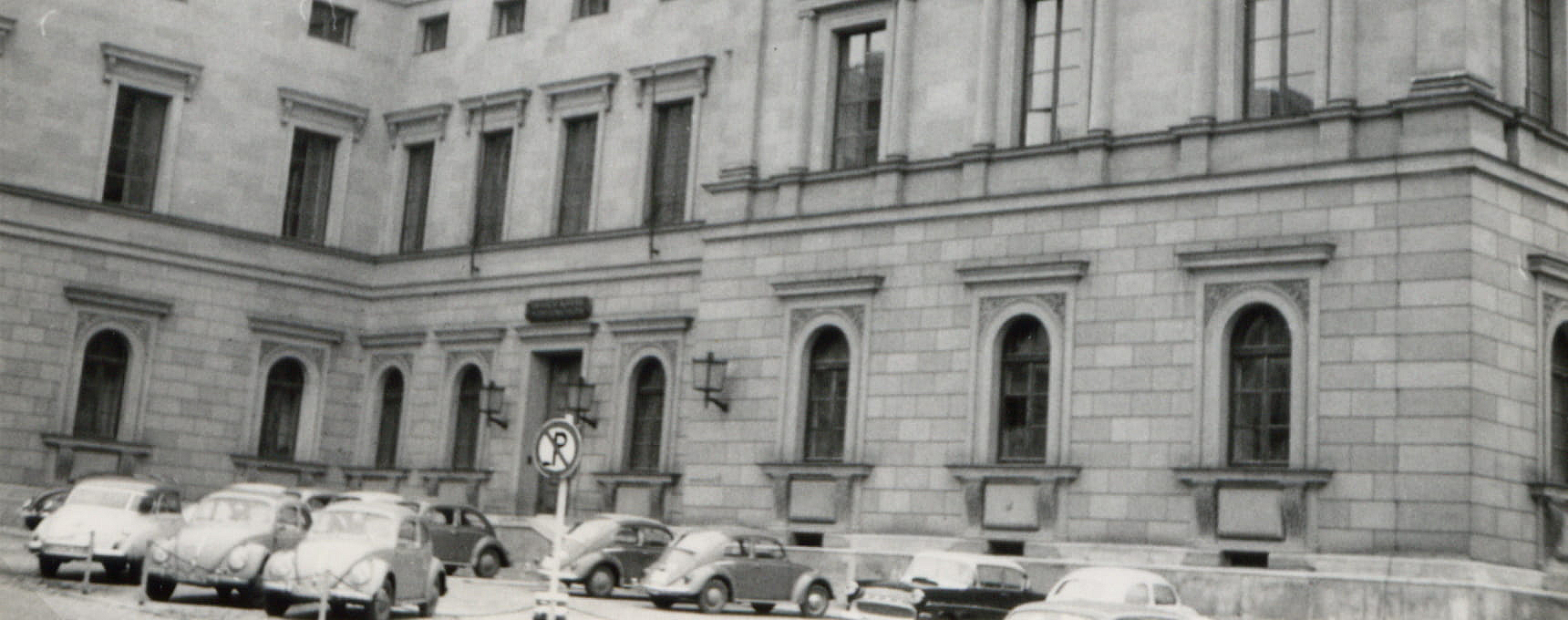
In July 1946, the military government allowed the Academy to fully resume its scientific activities. Under President Walther Meißner, the Academy moved to a temporary home in Schwabing, before celebrating its 200th anniversary in 1959 at its current location in the north-east wing of the Munich Residenz royal palace.
After 1945, there was a further major expansion of the Academy’s research activities. Alongside a number of humanities and science projects, the Walther-Meißner-Institute was founded in 1946, followed by the Leibniz Supercomputing Centre and the Commission for Glaciology in 1962.
During the 1950s, the prehistoric collection, the Egyptian collection and the coin collection were removed from the Academy along with the Museum for Ethnology and the Museum for Casts of Classical Statues. The natural sciences collections were placed under the general management of the Bavarian State Natural Science Collections.
In 1979, funding for humanities projects was overhauled with the establishment of the Academies Programme. Jointly financed by the federal and state governments, this programme is the most important source of external funding for humanities research at BAdW. As Germany’s largest programme for long-term research, it serves to give access to, preserve and explore the world’s cultural heritage. It is coordinated by the Union of German Academies of Sciences and Humanities.
Future fields and networks: the Academy in the 21st century
Since the beginning of the 21st century, the BAdW has modernised its structures and strengthened its national and international research networks, leaving a lasting mark on its profile.
The foundation of the Young Academy in 2010 set a clear signal of its intent to systematically support talented young researchers in Bavaria.
With the establishment of the Bavarian Research Institute for Digital Transformation in 2019, the Academy created a future-oriented institute dedicated to the key trends of the digital transformation and seeking to step up the dialogue between the scientific community, policy-makers, the business sector and society.
2021 saw the establishment of the Schelling Forum – a joint initiative of the Bavarian Academy of Sciences and Humanities and the University of Würzburg. It serves as the Academy’s field office in northern Bavaria, where it supports research activities and interdisciplinary exchanges between the scientific community and the general public.
The Academy is particularly interested in the field of quantum technologies. Two of its institutes, the Leibniz Supercomputing Centre and the Walter-Meißner-Institute, are key players in the Munich Quantum Valley project, founded in 2022. Thanks to funding from Hightech Agenda Bayern, this Bavarian alliance combines cutting-edge research, high-tech infrastructure and industrial partners to boost the development and use of quantum technologies.
In 2024, the Academy created AHA – The Science Communication Hub. The BAdW coordinates this network of leading Munich-based science institutes to bring communication of science topics to a wider audience in the city and in Bavaria as a whole.
Since 2025, the Academy has been involved as a cooperation partner in the second competition phase of the Excellence Strategy of the German federal and state governments with five Clusters of Excellence in Munich, Nuremberg-Erlangen and Bayreuth.