Statements and position papers
Scientific research is at the core of early recognition of transformation processes, the identification of opportunities and risks, and providing scope of action through scientific classification. Practical examples of this include how to deal with global crises, improving sustainability and resilience, the structural changes taking place in society and politics, the increasing polarisation of public debate, and the waning trust in scientific expertise. The Academy publishes statements and position papers on topical issues, thus contributing to evidence-based opinion-forming to support political decision-making.
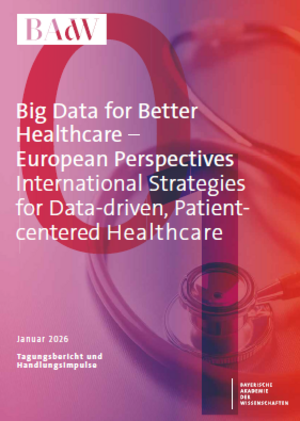
Big Data for Better Healthcare – European Perspectives. International Strategies for Data-driven, Patient-centered Healthcare
Large, high-quality healthcare datasets are crucial for progress in prevention, diagnosis and treatment, as well as for innovation in medical research and healthcare management. However, in Europe, structural shortcomings have so far hindered their systematic use, in particular fragmented IT landscapes, a lack of interoperability and heterogeneous governance models.
The conference in December 2025, organised by the BAdW, the Bavarian State Ministry of Health, Care and Prevention, and Dierks+Company, focused on key prerequisites, obstacles and success factors for the use of health data in Europe, whilst also providing a comparative overview of different European models.
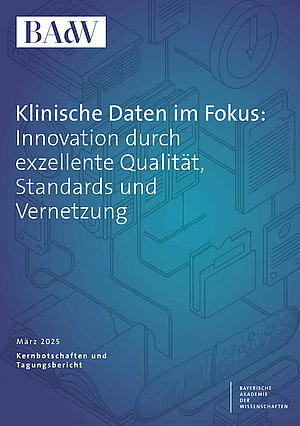
Focus on clinical data. Innovation through quality excellence, standards and networking
Digitalisation and artificial intelligence (AI) hold enormous potential for patient care, medical research and the commercial development of the healthcare sector. Electronic systems such as digital patient files and the telematics infrastructure are creating new opportunities, but in Germany their integration into everyday research remains incomplete. There is a lack of overarching infrastructure to make effective use of the data.
The conference in December 2024 – organised by the Academy, Dierks+Company consulting firm, the Bavarian State Ministry for Health, Nursing Care and Prevention along with the Bavarian State Ministry for Science and Art – looked at concrete approaches to solutions regarding best practice for standardising data collection, unifying infrastructure and harnessing the full potential of clinical care data.
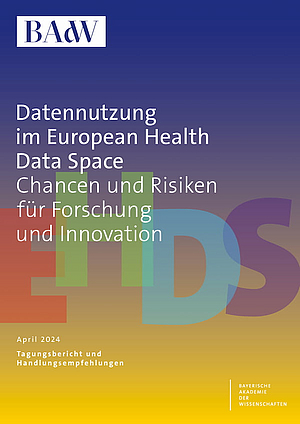
Data use in the European Health Data Space (EHDS)
In December 2023, the Academy organised a conference on the European Health Data Space (EHDS) in conjunction with the Bavarian State Ministry for Science and Art, the State Ministry for Health, Nursing Care and Prevention and Dierks + Company.
At this event, the opportunities and practical implementation of the European Health Data Space in Germany and Europe was discussed with representatives from the worlds of politics, medical technology and healthcare (including health insurers and hospitals) as well as groups advocating for patient rights and data privacy.
Use of personal data in healthcare and medical research
Adapting the legal framework and developing central structures for data storage: An interdisciplinary working group at the BAdW makes recommendations on the use of personal data in healthcare and medical research in Bavaria.
The position paper recommends:
- Strengthening a healthcare system with dynamic learning ability
- Adapting the legal framework
- Revising Art. 27 of the Bavarian Hospitals Act
- Introducing a Data Use Act in line with the GDPR
- Developing central data storage structures
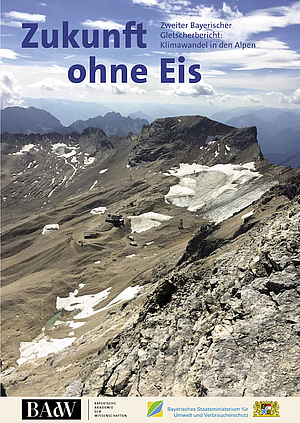
Climate change in the Alps: second Bavarian glacier report
The second Bavarian glacier report was created with the cooperation of the Bavarian State Ministry for the Environment and Consumer Protection.
Report findings:
- Glaciers are continuing to lose huge volumes of water. The northern Schneeferner glacier on the Zugspitze alone is melting at a rate of almost 250 litres every 30 seconds.
- It is conceivable that the last glacier in Bavaria will already have disappeared by the start of the 2030s.
- The main reason for glacier retreat is global climate change, with the rise in temperature in the Alps almost twice that of the global average.
- The mountains will become even less stable if the permafrost melts.
Further information:
- Press release: Glacier research in the age of climate change (2025)
- Press release: Glacier loss (2022)
- Press release: Glacier report (2021)
Islam in Bavaria
Based on broad empirical evidence, this first-time study in a territorial German state examines the opportunities of Muslims when it comes to equal participation in society. It provides breakthrough findings for the scientific community and policy-makers.
Key findings:
- The teaching of Islam in religion classes is key to creating a “culture of acceptance” and combating radicalisation.
- Refugees have much less close relationships with mosque communities than generally assumed.
- The experience of new roles has changed women in particular.
- Bavaria has no “parallel justice” with “sharia courts”, but there are traditional forms of dispute settlement.
- Salafism and Islamophobia pose threats to social cohesion. A “culture of acceptance” of Muslims is the only way to combat division in our society.
Bavarian glaciers and climate change: first Bavarian glacier report
The first edition of the Bavarian glacier report, created in cooperation with the Bavarian State Ministry for the Environment and Consumer Protection, shows that: Glaciers are signposts of climate change
Report findings:
- The Alpine glaciers may be slow in reacting to climate change, but they are massively impacted by the phenomenon.
- The progressive glacier loss in the Alps is not only affecting the environment, but also has consequences for the regional water cycle and opens the possibility of geo-risks.
- If climate change continues on its current trajectory, Bavaria’s glaciers are set to disappear almost entirely in the near future.